Posts

Showing posts with the label Enrichment analysis

Now published: Ten common mistakes that could ruin your enrichment analysis

Image
  Glad to share with you our published article  Ten common mistakes that could ruin your enrichment analysis . The work was done by Anusuiya Bora (Burnet Bioinformatics, Deakin Uni), Matthew McKenzie (Deakin) and I. My working group got interested into pathway enrichment analysis in around 2020/2021 because I was receiving review requests for manuscripts and many of them suffered from severe problems, leading me to believe that these issues were prevalent. Our first article on this theme  Wijesooriya et al, 2022  demonstrated that severe problems were really common across a big sample of peer-reviewed articles including: Lack of p-value correction. Wrong background list. Lack of methodological details. We showed that problems 1 and 2 led to dramatic biases in results that could alter the conclusions of transcriptome studies. Due to reviewer disagreements, we were unable to provide a more comprehensive set of best practices in that article, but this remained a priorit...

Workshop alert! Mastering Reproducible Enrichment Analysis

Image
 Join us for a 2-part workshop on Mastering Reproducible Enrichment Analysis! 📊 Presented by Anusuiya Bora and myself, with a focus on reproducibility and best practices. 📅 When: 12 and 13 May 2026  🕑 Time: 2:00 PM – 4:00 PM (AEST)  📍 Where: Online  💰 Cost: FREE for academic sector (places are limited!) 🔗Registration form link: https://tinyurl.com/ye262hzx

Mitch gets upgraded - now with gene set networks

Image
Interpreting pathway enrichment analysis results is a big challenge. There may be hundreds of statistically significant pathways from an analysis and getting to a shortlist of key mechanisms to follow up with experiments and describe in a publication is difficult. I recently got a request from a collaborator to come up with a way to visualise the key networks. I groaned... because network analysis in bioinformatics is sometimes characterised by showing hairballs of hundreds/thousands of meaningless interactions. Mostly it is done poorly and the charts themselves do not have any explanatory function and mostly appear to be decorative. After seeing a few well done examples such as Figure 2 from Chappel et al (PMID: 32138627), I thought this could be something we include as a common step in the mitch workflow. For those of you unaware, mitch is the R/bioconductor package that Dr Antony Kaspi and I published in 2020 (PMID: 32600408) with the main focus being on multi-dimensional enrichmen...

Two subtle problems with over-representation analysis

Image
Over-representation analysis is a helpful and really frequently used technique for understanding trends from omics data and gene lists more generally. Just to demonstrate this, I tabulated the number of citations of some of the most popular web tools and packages, which reaches a massive 191k citations! But if you have used some of these tools, you will notice that they yield subtly different results. We were curiuous about that and ran a whole bunch of investigations into the internal workings of these tools, in particular clusterProfiler. We identified two subtle problems with clusterProfiler, which we unpack in detail in our new publication , but here I will give you a quick overview. Problem #1: The background problem The first one we call the “background problem,” because it involves the software eliminating large numbers of genes from the background list if they are not annotated as belonging to any category. This results in removing a large number of unannotated genes from the b...

Don't use KEGG!!!

Image
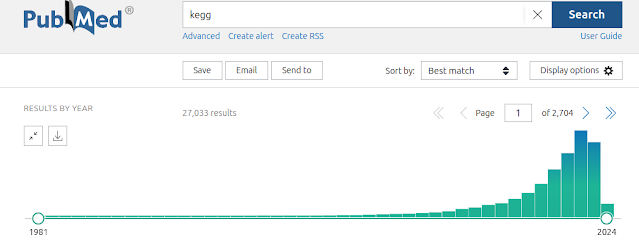
KEGG is the Kyoto Encyclopedia of Genes and Genomes, a compendium of gene functional annotations which are commonly used for pathway enrichment analysis. KEGG has been around since 1997 (PMID: 9390290) but in 2000, as the draft human genome sequence was released, KEGG became a key database involved in the curation of literature data to catalog the function of all human genes, many of which were newly sequenced and previously uncharacterised. This invigorated interest in KEGG is demonstrated by one of their articles in 2000 (PMID: 10592173) accruing 24,236 citations according to Dimensions , 1270 fold higher than other articles from that time. A PubMed search using "KEGG" keyword shows 27,033 results, with matches in abstracts alone and the tragectory is increasing at a rapid rate. Despite the popularity of this tool, I'm urging you not to use it for your research. Here I will lay out the reasons. 1. It isn't comprehensive I did an analysis of KEGG and other pathway se...